"Processed" is a Useless, Empty Descriptor of Food

I've seen a few confused, underdeveloped takes in various media about "processed" foods. Often these inchoate arguments are used as a cudgel against the burgeoning alternative food movement, which seeks to replace conventional meat, dairy, and other animal products. Here's an example from LinkedIn posted a few weeks ago:
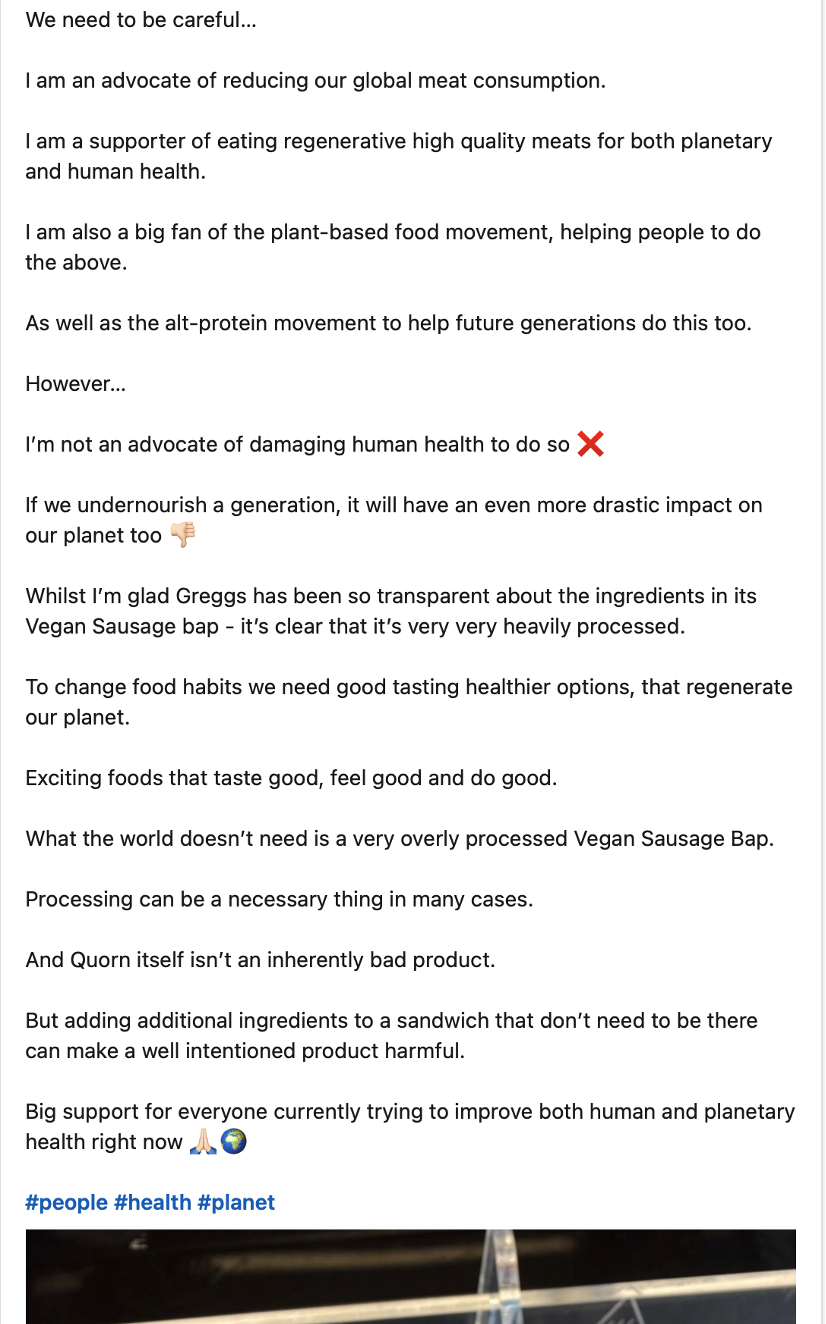
This molded-for-virality LinkedIn post has all the hallmarks: A litany of short, easy-to-read sentences, generously spaced out to reel in someone from mindless doomscrolling. Some sentences will capture your regard and, perhaps, your Like. And only a few of them are controversial enough to deter a scrupulous observer.
But taken as a whole, the post insidiously capitalizes on some implicit and bald assumptions about food while meekly declining to stick its neck out and spell out the author's reasoning. The author seems to argue that certain foods, in this case, a Vegan Quorn Sausage, are "very very heavily processed", and that's in contrast to "healthier options, that regenerate our planet."
The post implies that "processing" comes at the expense of how healthy and sustainable food is. It's not only an unscientific, baseless meme but a counterproductive one to indulge and spread. If we, humanity, truly want tasty, affordable, healthy, kinder, and more sustainable food, then we need better descriptors.
The first issue is that "processed" is meaningless and fluid as an adjective. And the above post clarifies none of the confusion. What is processed? Is that number of chemical or mechanical transformations on food? If that's so, then every animal product is highly processed. A cow, a bioreactor for food production, chemically transforms the grass and grains consumed by breaking down the starches into constituent sugars. The cow's metabolism chemically converts those sugars into thousands, if not millions, of molecules such as amino and fatty acids. The amino acids build into proteins, forming the eventual meat or milk. Dairy products are further mechanical and chemical transformations of cow milk. The resultant label obscures all these steps because the ingredient list can just say "milk, cultures" due to outdated labeling laws. But really, the ingredients are "lactose, lactic acid, butyric acid, caproic acid, caprylic acid, potassium, a-casein, b-casein, k-casein, lactoalbumin, heptanoic acid, sodium, potassium, magnesium, chloride,"… and thousands more.
If we contend that the amount of processing is equivalent to chemical or mechanical transformations, then fruits and vegetables are highly processed too. Plants convert carbon dioxide, water, and minerals into a concatenation of molecules: fiber, ascorbic acid, protein, oils, sugar, vitamins, etc. A tomato's label of all the contained compounds would be extensive like it would be for meat and dairy.
When discussing how healthy a food is, the only thing we need to evaluate is the food itself, not simply how we created it. What ultimately matters are latent chemical ingredients and how our bodies metabolize them. Our saliva, stomach, and intestine work together to break down food into its chemical constituents: the individual amino acids, fat molecules, sugars, and minerals. Once we digest our food into separate chemicals, our body can turn them into tissue, blood cells, and energy. Listing out lactose, lactic acid, and so forth was not just for the writing effect; it's what our bodies nutritionally interrogate in our food.
I also want to tackle any tenuous connection between how "processed" food is and purported planetary devastation. I've written extensively about how animal agriculture is arguably the most environmentally destructive industry on the planet–more than the transportation and energy sectors, in my view. The destructiveness stems from the stark inefficiency and scale of using animals as bioreactors. It's not just about emissions; it's also about animal agriculture capturing a third of the ice-free land on Earth. Renewable animal agriculture doesn't solve the underlying inefficiency of animal bioreactors; in fact, it uses more land than factory farming. Instead, plant and microbial-based foods are our best solutions. A bathtub-sized microbial bioreactor could replace a cattle operation with 10,000 heads–a massive land, emission, and resource saving. Indeed, a recent publication calculated that replacing a mere 20% of beef production with microbial-based Quorn would slice deforestation in half. Renewable animal agriculture is a complicated distraction–a shiny Rube Goldberg machine. There are better, more effective ways to solve the underlying problem.
If one still believes "processed" can be a helpful adjective, I suggest the following exercise: Come up with a precise definition for what "processed" means. Does the definition somehow only encompass unhealthy or harmful foods for the environment? Is the description going to say that raw honey and kale smoothies are unprocessed or processed? Feel free to comment or message me to pressure test the definition. Instead, we already have more precise, helpful metrics and ways to evaluate food: digestibility, protein content, fiber distribution and content, vitamin content, and quantity of free sugar all come to mind.
In summary, "processed" is a useless, empty descriptor concerning food. It's fallacious to draw any conclusion about Quorn Sausage and Impossible Burgers based on the length of their ingredient list or how "processed" they are. With better metrics, many alternatives have proven to be much healthier and more sustainable than their conventional animal-based counterparts. A recent paper evaluated the case of sausages, with the vegan and vegetarian alternatives winning decisively.
I've long argued that we can have food that's healthier, tastier, and more affordable while winning on ethics and the environment. Such food can only happen if we give up animals as bioreactors and have valuable food descriptors. As someone who works in the alternative food space, I can proudly say that we're highly motivated to put forth nutritionally impressive products. To assess the salubrity of our prototypes, we employ a slew of descriptors. "Processed" is not one of them.
Photo by ArtHouse Studio.